ナレッジセンター
Advancing Tire Performance with Next Generation Bio-based Tread Enhancement Additives
As mobility trends evolve, tire manufacturers are under growing pressure to deliver safer handling, longer life, and better fuel economy. These demands grow even stronger as electric vehicles place higher loads on tires and amplify the need for low rolling resistance. At Tire Technology Expo 2026, Kraton highlighted how pine-based tread enhancement additives support these needs while helping formulators meet their sustainability targets.
Meeting New Material Challenges
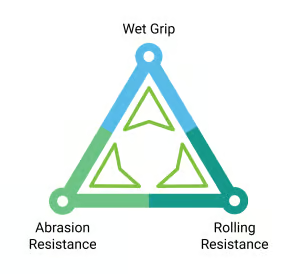 Safety remains the top priority for the tire industry. Wet grip, rolling resistance, and wear resistance must all be optimized, all while expectations around sustainability continue to increase. These performance goals coincide with a shift in elastomer design, wherein styrene content in solution-polymerized styrene butadiene rubber (sSBR) continues to decrease.
Kraton’s SYLVATRAXX™ TEA™ technology provides a reliable tool for supporting performance as elastomer chemistries change. TEA are viscoelastic modifiers that tune compound behavior as a non-reactive additive. Their ability to influence polymer compatibility and filler interaction helps expand the performance triangle of wet grip, rolling resistance, and abrasion resistance.
Kraton’s SYLVATRAXX portfolio includes pure aromatic monomers, rosin-based, modified terpene, and polyterpene grades, many with high bio-based content, sourced from responsibly managed forests. These materials support improved life cycle outcomes and reinforce industry-wide sustainability objectives.
Compatibility with Lower Styrene sSBR
As styrene content in sSBR is continually reduced, sometimes as low as 10 or 5%, SYLVATRAXX plays a key role in maintaining wet grip performance. Aliphatic resins are expected to provide good compatibility.
When styrene content is decreased, formulators can compensate for lowered glass transition temperature (Tg) values by increasing the loading of SYLVATRAXX grades, helping maintain compound Tg.
Lower styrene content in styrene butadiene rubber (SBR) also improves mixing behavior, with overall mixing torque being reduced as styrene percentages decrease and SYLVATRAXX loadings increase. SYLVATRAX 8115 has shown a consistent reduction in mixing torque during laboratory compounding. Based on our research around the Payne Effect in SYLVATRAXX formulations, low styrene formulations are also expected to have an improved level of silica dispersion.
In medium styrene sSBR formulations, there was little difference in parameters between different SYLVATRAXX grades. SYLVATRAXX 5216, with a higher Tg, requires a lower dosage in formulations to maintain required compound Tg.
When reviewing SYLVATRAXX grades for wet grip indicator, medium styrene formulations showed SYLVATRAXX 5216 had the best performance, with SYLVATRAXX 4401 and 2097EU performing equally at slightly lower tanδ0°C values. The best performance for Rolling Resistance indicator is shown with SYLVATRAXX 4401.
In low styrene SBR formulations, research shows several improved parameters when compared to medium styrene SBR formulations. Mooney viscosity is reduced, scorch time increased, elongation at break increased, and hardness lowered. Preliminary research implies that these differences are linked to the silica dispersion because of the use of low Tg sSBR and higher SYLVATRAXX content.
Wet grip indicator results for low styrene formulations showed using SYLVATRAXX 5216 the best performance, followed by SYLVATRAXX 4401 and 8115, and SYLVATRAXX 2097 EU with the least, albeit similar, performance. The best performance for Rolling Resistance indicator is shown with SYLVATRAXX 4401.
A More Sustainable Path Forward
Pine-based chemistry offers a dependable route toward improved tire performance with meaningful sustainability benefits. SYLVATRAXX products with high biobased content and ISCC PLUS certified production support responsible sourcing and reduced environmental impact. Their ability to enable lower energy mixing, maintain wet grip, and enhance rolling resistance positions them as key tools for the next generation of tire design.
As elastomer innovation continues, the industry will rely on additives that deliver performance, efficiency, and sustainability at the same time. Kraton’s SYLVATRAXX™ TEA™ technology provides a proven path to achieving these goals. Through continued development of AMS, rosin, and polyterpene chemistries, Kraton remains focused on helping tire manufacturers deliver safer, more efficient, and more sustainable mobility solutions.
参考文献
詳細についてはニュース、サクセスストーリーをご覧ください。