Case Study
NCATテストセクション
Building Thinner Pavements That Perform
How Kraton and NCAT Prove What is Possible with HiMA Technology
Transportation agencies face a growing challenge as traffic volumes are increasing, loads are heavier, and expectations for pavement durability and sustainability continue to rise. At the same time, budgets and material availability remain constrained. At Kraton, we believe innovation must be proven at full scale, under real-world conditions, to help roadway owners confidently move forward.
That belief is why Kraton partnered with the National Center for Asphalt Technology, known as NCAT, to validate the performance of our HiMA bitumen technology through full-scale accelerated pavement testing.
挑戦
Thin Pavements Without Compromise
Designing thin pavements that resist rutting or cracking is well understood. Designing pavements that do both, especially at reduced thickness, is far more difficult.
As pavement structures become thinner, traditional polymer-modified binders often force designers into tradeoffs:
- Stiffer mixtures improve rut resistance but increase cracking risk
- More flexible mixtures reduce cracking but deform under traffic
- Reduced thickness amplifies both risks
Seeking thinner pavements to lower costs, reduce emissions, and minimize traffic disruptions, the question is clear: Can thin pavements deliver long-term reliability on high-traffic roads?
解決策
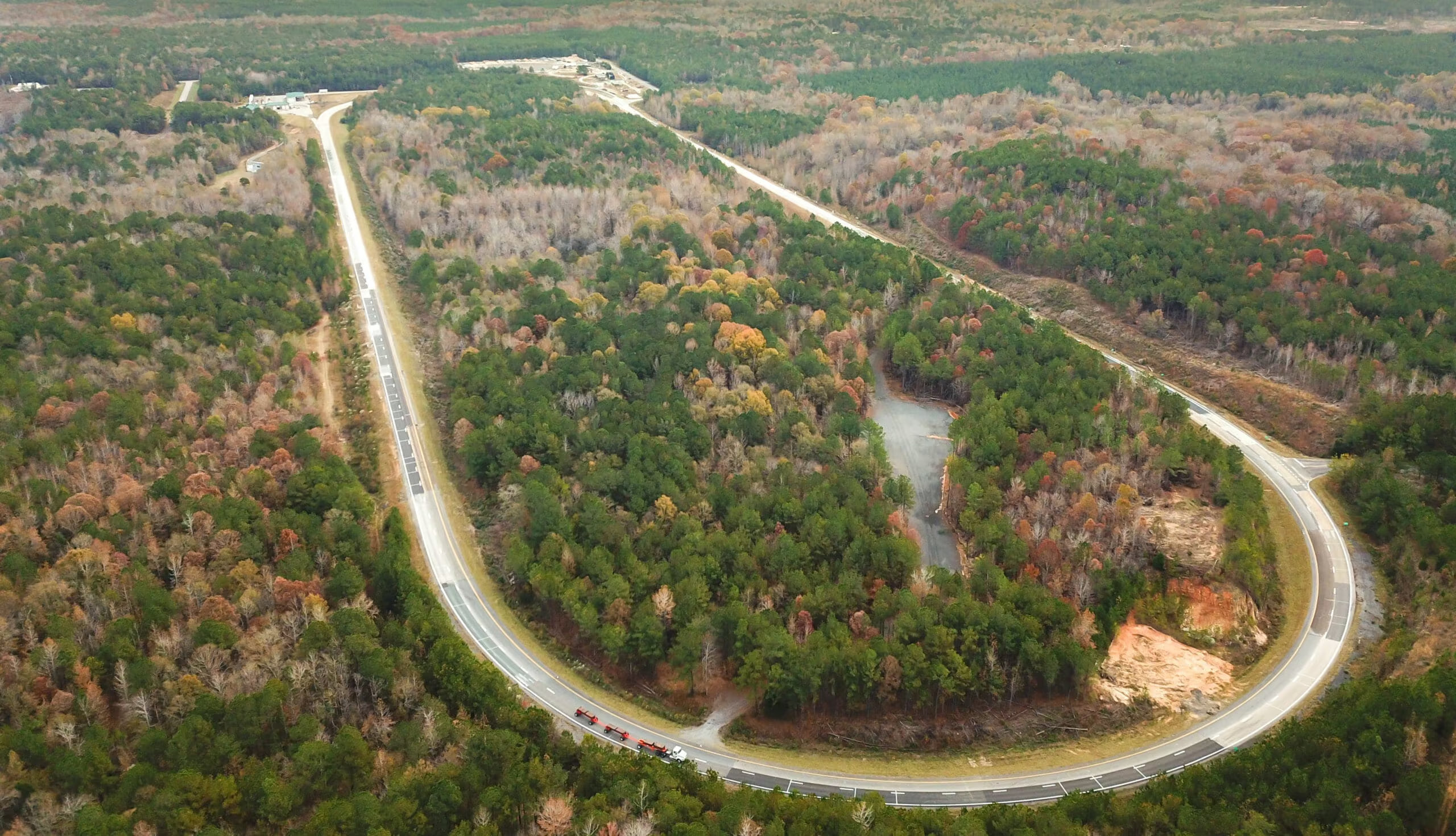
The NCAT N7 Test Section with HiMA
To answer that question, Kraton worked with NCAT to construct and evaluate the N7 test section at NCAT’s full-scale accelerated pavement testing facility at Auburn University in Alabama. NCAT is globally recognized for its ability to simulate decades of truck traffic in a controlled, high-speed environment.
The N7 test section was intentionally designed to challenge conventional assumptions.
Pavement Structure and Materials:
- Three layers of asphalt pavement constructed over 14 cm (5.5 in) of aggregate base
- Total asphalt thickness of 14.6 cm (5.75 in)
- Approximately 18% thinner than the conventional control section
Layer Details:
- Wearing course: 3.2 cm (1.25 in), with a 9.5 mm NMAS dense graded mixture
- Base course: two layers, which were each 5.7 cm (2.25 in) with a 19 mm NMAS dense graded mixture
- All asphalt layers used Kraton HiMA bitumen technology
Production and Placement:
- HiMA mixtures produced at 174°C (345°F)
- Compaction temperatures ranged from 115 to 147°C (240 to 295°F)
The control section used a conventional polymer binder and a thicker pavement structure, reflecting typical industry practice.
Measured Performance Under Real Traffic
Both sections were subjected to 20 million equivalent single axle loads (ESAL) over five years, simulating heavy truck traffic well beyond what many pavements experience in service.
The results were decisive:
- The HiMA N7 section exhibited 70% less rutting than the control section
- No bottom-up fatigue cracking was observed in the HiMA section
- The control section showed fatigue cracking across 18% of the surface area
These outcomes demonstrate that a thinner pavement, when engineered with the right material technology, can outperform a thicker conventional design in both deformation resistance and fatigue life.
影響
Why This Matters Beyond the Test Track
The NCAT N7 results provide more than laboratory validation. They offer practical, data-driven confidence for roadway owners considering thinner pavement strategies.
Key Benefits Observed:
- Longer service life potential with reduced thickness
- Improved reliability under heavy traffic
- Reduced material usage and associated emissions
- Strong life cycle value compared to conventional PMB solutions
By enabling thinner pavements that last longer, HiMA technology supports goals related to sustainability, economic efficiency, and network reliability.
Partner(s):
National Center for Asphalt Technology (NCAT)
結論
From Test Track to Real World Application
Since the NCAT Phase IV study, Kraton HiMA technology has been successfully implemented in high-traffic corridors worldwide, including demanding urban environments where thin overlays must perform immediately and over time.
These projects reinforce the same lesson demonstrated at NCAT. Pavement performance does not have to be sacrificed to achieve thinner designs. When material science is prioritized, durability and efficiency can advance together.
After 20 million ESALs, the HiMA N7 test section delivered 70% less rutting and zero bottom-up fatigue cracking, despite being 18% thinner than the conventional control section.
Proven Innovation That Changes the Conversation
At Kraton, innovation means more than introducing new products; it means validating performance through collaboration, transparency, and real-world testing. The partnership with the National Center for Asphalt Technology demonstrates what is possible when advanced materials are combined with rigorous evaluations.
For roadway owners facing increasing demands and limited resources, HiMA technology offers a proven path to thinner, longer-lasting pavements that deliver measurable life cycle value. The data from NCAT confirms that the traditional tradeoff between thickness and durability no longer has to define pavement design.
関連製品および情報
参考文献
詳細についてはニュース、サクセスストーリーをご覧ください。
バイオ由来粘着付与剤による接着剤のカーボンフットプリント削減
サステナビリティへの期待が高まる中、接着剤メーカーには、性能を犠牲にすることなく環境負荷を低減することが求められています。再生可能素材の活用は、規制要件への適合やカーボンフットプリントの改善、さらには幅広い用途におけるリサイクル性の向上を実現する上で、有効な道筋となります。ポーランド・ヴィスワ県道 DW942
観光業が盛んな地域では、季節ごとに繰り返される交通量の急増に耐えうるインフラが求められます。ポーランドのヴィスワ(Wisła)におけるこの課題は、耐久性、持続可能性、そして費用対効果をいかにして信頼性の高い形で両立させるか、そのあり方を見直す好機となりました。チェコ・プラハ、ヴァーツラフ・ハヴェル空港滑走路
世界的に航空利用が拡大し続ける中、空港のインフラには、滞りなく機能し続けることがこれまで以上に強く求められています。空港運営者が直面している課題は、単に老朽化した舗装を補修することではなく、将来の利用者に備えて舗装を万全な状態に整えることなのです。