Life Cycle Assessments
In today’s world, we must understand our customers’ goals and create sustainable product solutions to meet their needs. In practical terms, we achieve this by taking a product life cycle approach to identify opportunities for sustainable market-driven innovations. We have conducted cradle-to-gate life cycle assessments (LCA) on key product lines to improve our understanding of our product’s environmental impacts, such as greenhouse gas emissions.
Our LCA’s allow us to make informed decisions and identify if optimizing the production process or raw materials could improve the product’s environmental footprint. LCA’s are essential to foster closer engagement with suppliers, supply chain partners, and customers around their products and move towards improved sustainability in the value chain and society overall.
Product Life Cycle
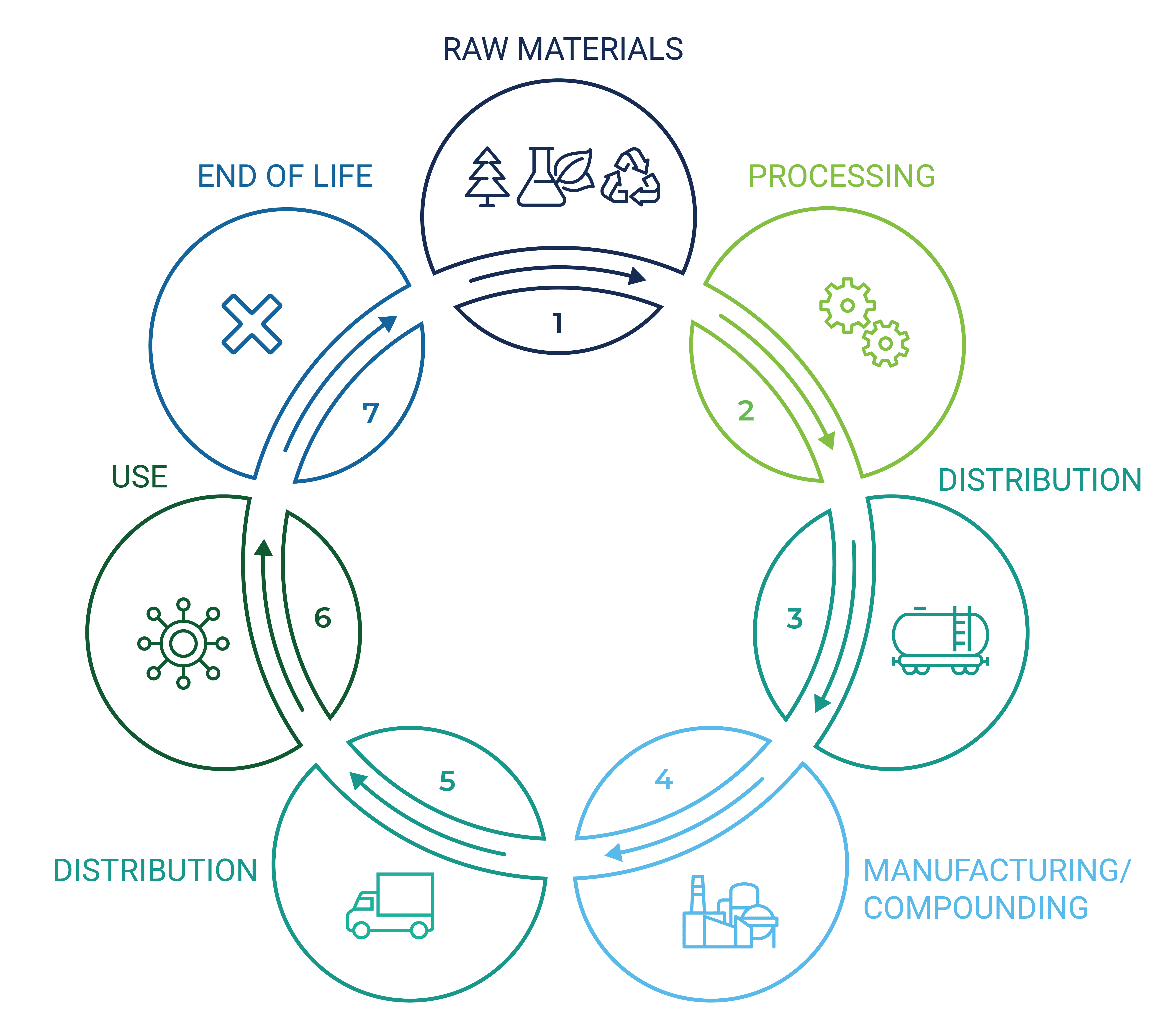
Raw Materials
Reduce upstream corporate emissions and the product carbon footprint (PCF) of products by shifting to renewable raw materials with a lower PCF.
Processing/Manufacturing
High-performance raw materials can reduce energy consumption, waste or water consumption, and/or volatile organic compound (VOC) emissions and allow for safe handling and meeting health & safety requirements.
Use
High-performance raw materials may help extend life, improve product performance, reduce weight, and lower energy consumption in use. Together, these benefits help reduce the overall PCF.
End of Life
Raw materials with plastic modification features like Kraton’s styrenic block copolymers (SBC) can enable the re-use of components or the recycling of raw materials.
Applying Lessons from Life Cycle Assessments
Future innovation processes may benefit from this information by helping us spot changes to increase overall product sustainability in ways like:
With the help of LCAs, we can provide our customers with items that have a smaller negative impact on the environment. LCAs open doors for closer cooperation with suppliers, supply chain partners, and customers.
LCA Spotlight
Life Cycle Case Study: Interface, Inc.
Interface, Inc., the world’s largest manufacturer of modular carpet, worked with Kraton to develop a bio-based carpet tile backing. Learn how Kraton worked with Interface to evaluate the long-term impacts of the product to ensure low environmental impact.