Case Study
Paving for Studded Tires in Alaska
Rethinking Pavement Performance in Cold Climates
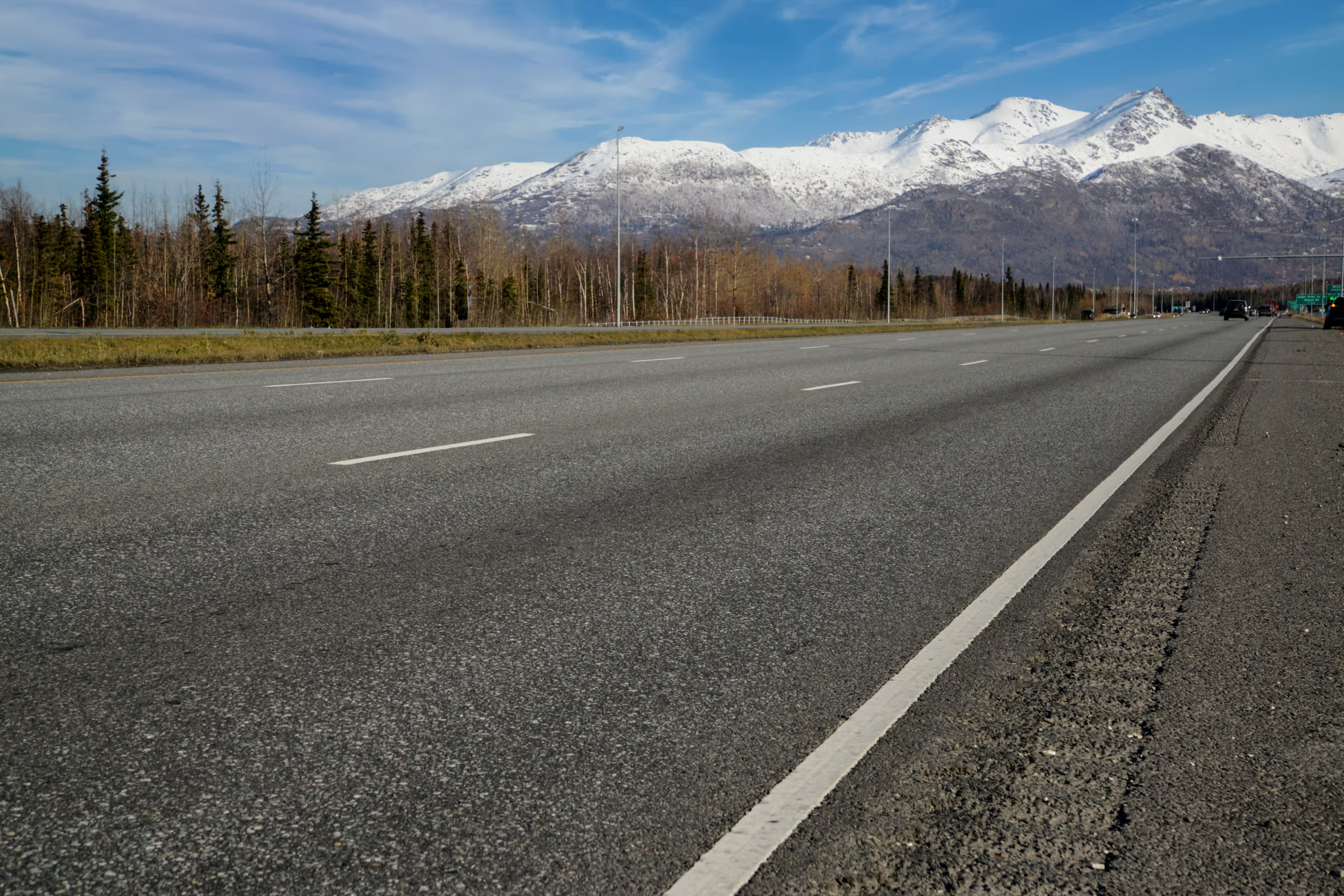
Lessons from Alaska’s Studded Tire Challenge
Across cold regions, studded tires remain essential for safety, but they also come at a cost. For road owners, the real question is no longer whether damage will occur, but how to extend pavement life despite it.
Challenge
A Systemic and Costly Issue
For transportation agencies across Alaska and the Pacific Northwest, studded tire wear is not a localized issue, but rather a systemic infrastructure challenge with long-term consequences.
Research from the University of Alaska Anchorage estimated that mitigating studded tire damage in Alaska alone can cost around $203.2 million over 20 years.
The impact is especially pronounced in high-traffic urban corridors like Anchorage, where pavement wear accumulates quickly. Field observations show average wear rates of up to 1/8 inch (3 mm) per year, accelerating maintenance cycles and increasing lifecycle costs.
This creates persistent tension on whether to maintain safety with studded tires or reduce roadway deterioration and budget strains.
Traditional solutions, such as harder aggregates or optimized mix designs, have improved performance, but they have not solved the fundamental issue of accelerated rutting under studded tire traffic.
Solution
Designing for Reality, Not Ideal Conditions
The key insight for engineers and asset owners is: pavement design must account for real-world conditions, not idealized loads.
Studded tire wear behaves differently than heavy truck loading. In fact, studies show that wear from passenger vehicles using studded tires can exceed deformation caused by truck axle loads. This changes the design equation.
Instead of focusing solely on structural strength, road owners need materials that:
- Resist abrasion from repeated tire-stud contact
- Maintain surface integrity under both low temperatures and high traffic
- Extend service life without increasing maintenance frequency
High-Performance Polymer-Modified Asphalt
In Anchorage, Alaska, the Department of Transportation & Public Facilities (DOT&PF) evaluated a different approach and incorporated a highly-modified asphalt binder into the wearing course.
The project applied a PG 64E-40 HiMA™ binder in a high-traffic downtown corridor, 5th and 6th Avenues, where traffic volumes can reach up to 10,000 – 15,000 vehicles per day.
Rather than relying on incremental improvements, this approach focused on fundamentally enhancing the asphalt binder’s resistance to rutting and wear.
Impact
Measurable Performance Gains
The results demonstrate what’s possible when pavement design aligns with real-world stressors.
After four years of service, including multiple winters with studded tire use, the observed rut depths were:
- 204 in (5.2 mm) on 5th Avenue
- 198 in (5.0 mm) on 6th Avenue
These results represent sustained performance under some of the most demanding conditions for asphalt pavements.
A second validation came from the Glenn Highway:
- HiMA section: 0.21 inches (5.3 mm) rut depth after 2 winters
- Conventional approach (PG 64-34 with ground tire rubber): 0.32 inches (8.1 mm)
This reduction in rutting, by roughly one third, translates to a 50% increase in pavement life before resurfacing is required, significantly improving life cycle economics.
What This Means for Infrastructure Decision-Makers
For road owners facing similar challenges, the takeaway is not just about one project; it’s about a broader shift in pavement strategy.
Key considerations moving forward:
- Life cycle value over upfront cost: Materials that reduce maintenance cycles can deliver substantial long-term savings
- Design for dominant stressors: In cold regions, studded tire wear, not just heavy loads, should guide material selection
- Scalability matters: Proven performance in urban test corridors can inform specifications for highways and regional networks
Alaska DOT&PF’s decision to specify the same HiMA binder for additional projects highlights confidence in this approach.
Partner(s):
Alaska Department of Transportation & Public Facilities
Conclusion
The challenge of studded tire wear is not going away, but it is becoming more manageable.
By shifting from incremental improvements to performance-driven material design, road owners can extend pavement life, reduce costs, and improve roadway safety at the same time.
The lesson learned in Alaska: When infrastructure is designed for real-world conditions, performance follows.
Related Products and Information
Further Reading
Explore additional insights, news, and success stories.
Advanced Thermoplastic Elastomers
As regulatory scrutiny increases and demand grows for more sustainable, compliant, and cost-effective materials, manufacturers are seeking alternatives that can deliver silicone-like performance without the limitations of conventional silicone systems. Oil-free TPS compounds offer an opportunity to address performance, processing,...Driving Sustainable Innovation with IMSS™
Automotive manufacturers face increasing pressure to improve sustainability, reduce emissions, and lower vehicle weight without compromising performance. Kraton's IMSS™ technology provides an alternative to traditional polyvinyl chloride (PVC) soft skins, helping Original Equipment Manufacturers (OEMs) address evolving environmental and manufacturing...REvolution™ Rosin Ester Technology
Formulators need materials that advance sustainability without sacrificing color, stability, or adhesion. Kraton's REvolution™ technology provides a high-performing, bio-based alternative to hydrocarbon resins, helping adhesives and thermoplastic road marking applications reduce reliance on fossil-based materials while maintaining critical performance characteristics.