Case Study
London’s M25 Orbital Motorway
Rethinking Road Maintenance

Scaling Sustainability Without Compromise
When opened in 1986, the M25, or London Orbital Motorway, was the longest ring road in Europe at 188 km (117 mi). Since then, the motorway has continuously served Greater London’s growing traffic demands.
Challenge
As one of the UK’s most important roadways, the M25 requires maintenance solutions that can perform under constant traffic demand while also addressing the growing need for more sustainable infrastructure practices.
Recognizing the finite nature of road-building resources and the increasing demands tied to pavement maintenance, FM Conway, one of Britain’s leading infrastructure companies, sought a better way to maintain the M25. The challenge was clear: develop a resurfacing solution that reduces reliance on virgin materials without compromising the durability expected on a strategic road network.
Solution
In collaboration with Toppesfield, FM Conway designed a special asphalt mix for resurfacing a section of the M25. The innovative design enabled the use of 50% recycled asphalt in the surface mix.
To support such a high level of recycled material, the mix incorporated a bespoke premium polymer-modified bitumen (PMB). According to FM Conway, the PMB was added to significantly improve the surface course durability by enhancing resistance to rutting and cracking.
Before the material was applied on the motorway, FM Conway carried out extensive laboratory testing. The evaluation demonstrated that this more sustainable solution could deliver performance comparable to conventional surface treatments, which typically contain only up to 10% recycled material.
Impact
The result was a meaningful step forward in road maintenance innovation. FM Conway’s 50% recycled content asphalt mix became the first of its kind to be used on the UK strategic road network.
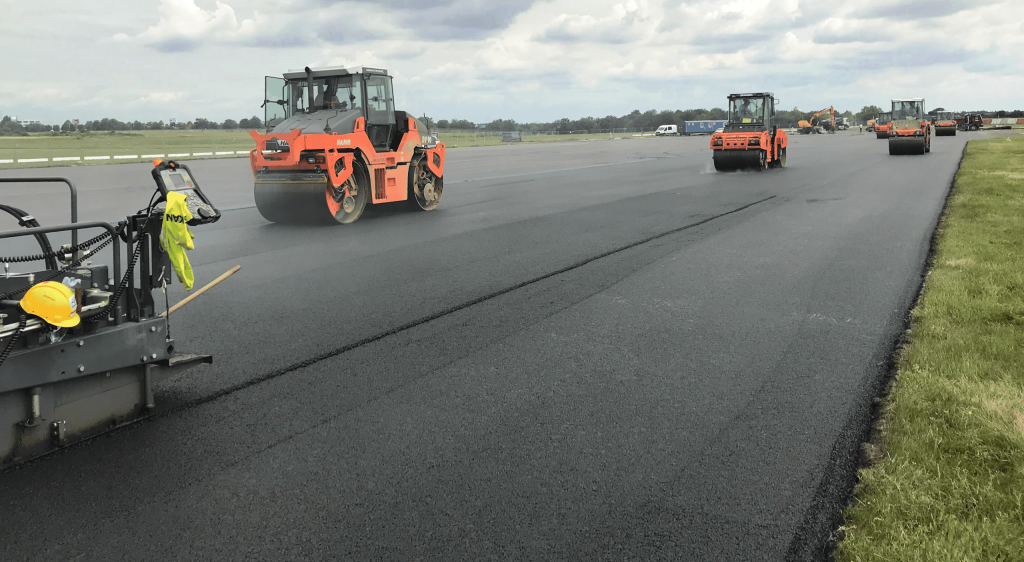
In September 2019, the company applied the solution of the M25 between junctions 25 and 26, laying a 4.5 cm (1.8 in) thick surface layer. This application showed that higher recycled content in asphalt is not just a sustainability goal. It can be a practical, performance-driven solution for critical infrastructure.
The significance of this work lies in what it proves. With the right formulation and testing, road maintenance can conserve resources, support long-term pavement performance, and help infrastructure owners take a more sustainable approach without lowering standards.
Partner(s):
FM Conway, Toppesfield
Conclusion
The M25 story demonstrates that innovation in infrastructure is most powerful when it solves a real operational challenge. By developing and validating a resurfacing solution with 50% recycled asphalt, FM Conway showed that sustainability and performance do not need to be competing priorities.
For the road industry, that is an important message. The future of pavement maintenance will depend not only on preserving critical networks like the M25, but on doing so with smaller materials choices that make better use of limited resources.
Related Products and Information
Further Reading
Explore additional insights, news, and success stories.
Reducing Adhesive Carbon Footprint With Bio-based Tackifiers
As sustainability expectations increase, adhesives manufacturers must reduce environmental impact without sacrificing performance. Renewable materials offer a pathway forward, helping companies meet regulatory requirements while improving carbon footprint and supporting recyclability across a range of applications.Voivodeship Road DW942, Poland
Tourism-driven regions require infrastructure that performs under constant seasonal traffic surges. In Wisła, Poland, this challenge created an opportunity to rethink how durability, sustainability, and cost efficiency can work together in a dependable way.Václav Havel Airport Runway
As global air travel continues to rise, airport infrastructure is under increasing pressure to perform without disruption. The question facing operators isn’t just how to repair aging pavements, rather how to ensure the pavements are ready for future travelers.